Too much manual work for a small team
The campaign that takes a day to build and sends in four seconds
Maestra Platform builds it once and reuses it, an all-in-one retention marketing platform for ecommerce brands where a forward-deployed marketer does the assembly.
Brands running on Maestra






The problem
Merchandising and personalization shouldn't be a manual job
Picking products for every recommendation slot by hand doesn't scale past a handful of pages. Teams end up leaving most of their catalog without proper recommendations simply because there isn't time to curate it all.
What we hear from brands
a handbag brand: a small ecommerce team manually manages merchandising and A/B tests, limiting scale
a four-person accessories brand: struggling to manually choose products for campaigns and research bestsellers
a city sports-merch retailer: a clunky, manual product-to-campaign workflow, a small team stretched thin
The new way
Migration is 99% someone else's job
Your forward-deployed marketer handles data migration, integrations, domain warming, and flow rebuilding, while your old stack stays live until the new setup is complete. Sena's team migrated contacts, flows, templates, and segments across two Klaviyo accounts in just two weeks.
Outcomes brands report
Customer proof
REKS put twenty-five hours a month back into the week

Bulk campaigns had been assembled by hand, one at a time, every month. Templates and reusable blocks removed the assembly, and the same team turned the saved hours into two and a half times the return.
 Read the full case study
25
hours of marketing team time saved per month
How it works
Who does what during the switch
You approve the plan
Access to the current stack and a yes to the migration plan is the whole ask on your side.
Your marketer rebuilds
Data, flows, and campaigns are rebuilt on Maestra while the tools you are leaving keep sending, including the domain warm-up that protects deliverability.
You switch when it is ready
Two to four weeks for growing brands, three to seven for the most complex setups, and 99% of the work sits with your marketer either way.
The platform
The modules were never meant to be bought separately
Segmentation, messaging, recommendations, and site personalization all read one profile, so a change in any of them is visible to the rest immediately. That is the part a stack of best-of-breed tools cannot reproduce with connectors.
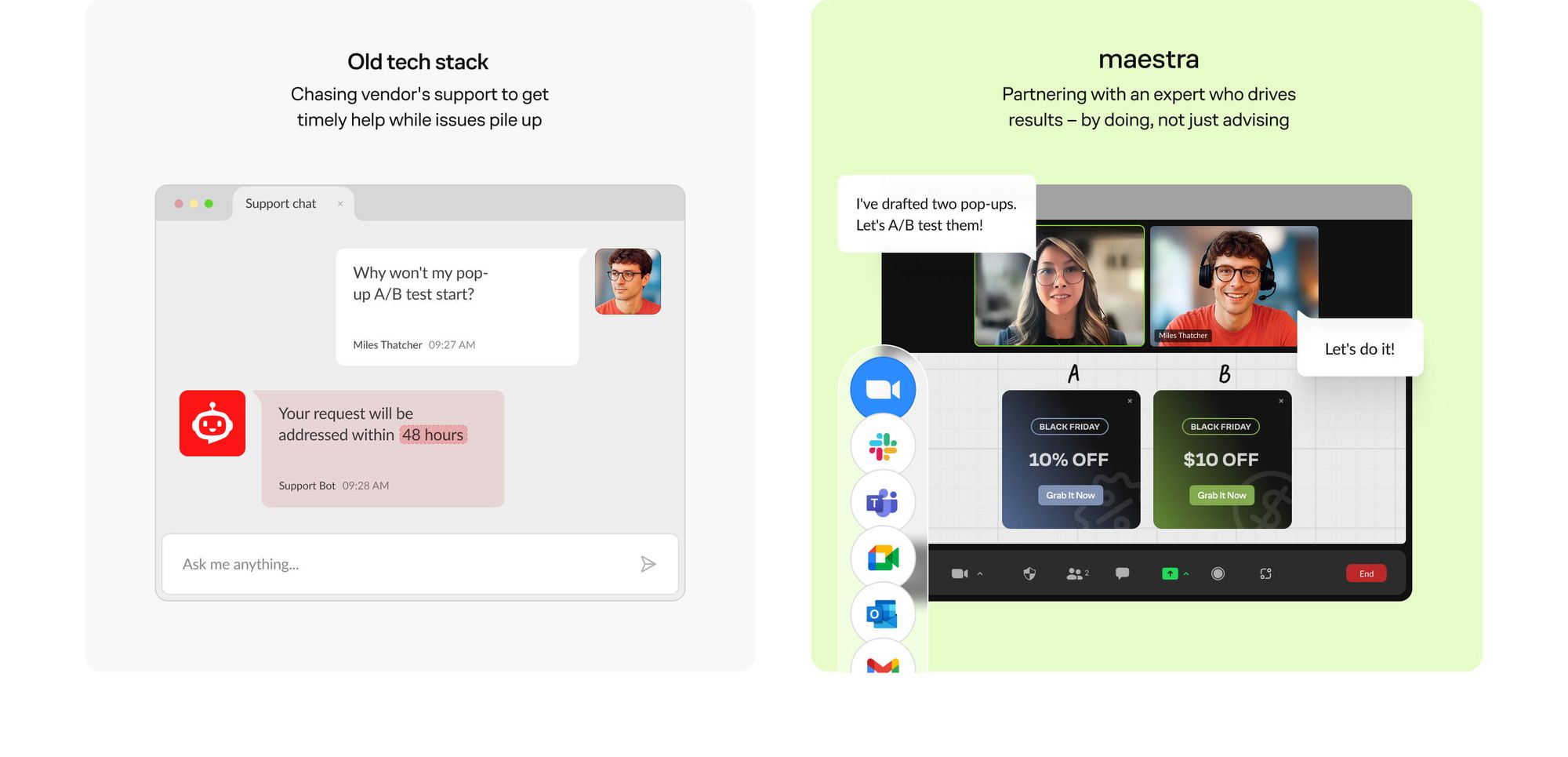
Your forward-deployed marketer
Deliverability is somebody's job here
Domains, sender signatures, and Postmaster are configured at migration and watched afterwards, with inbox placement treated as a metric rather than a complaint to answer.
Domains, signatures, and Postmaster configured for you
Email health monitored, not just reported
Warm-up handled during migration
Replace your stack
Agency plus point tools, priced honestly
The common setup is several subscriptions and a retainer for the people who operate them. Here the operating is included, which changes what the comparison is actually between.
The next step is smaller than a migration
Look at the platform, ask what your first month would look like, and decide after that.